
Loading component...

June 16, 2026
Individual bonds can be at the core of many principal-protection strategies because they offer predictable income streams and return of principal at maturity.1 The question is, how do they fit inside your portfolio?
A bond ladder has evenly staggered bond maturities like steps on a ladder. As the shorter-term bonds mature they are then reinvested at the longest point of the ladder.
A bond barbell invests half the assets in short-term bonds and the other half in longer-term bonds to balance liquidity from shorter maturities.
On the surface, both spread your money across multiple bonds. The difference lies in how that spread works and understanding that difference is the key to picking the structure that serves your life goals.
Both approaches are valid, but they're optimized for different people, with Ladders more suited to an income investor and a Barbell strategy attractive to a more active investor. What kind of investor are you? Ask yourself the following questions before you decide.
"The biggest mistake investors can make is treating bonds like stocks and watching the price every day. The moment you commit to holding to maturity, most of that anxiety disappears. That's the discipline both strategies are built around," said John Tolar, InspereX Head of Fixed Income and Institutional Sales.
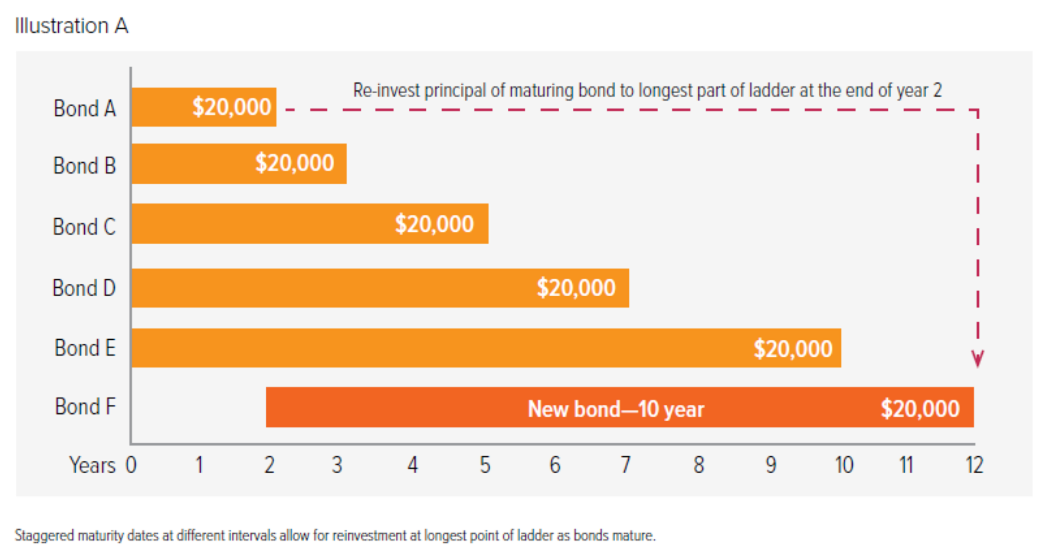 | Illustration A2 shows the initial investment of $100,000 that is split, or laddered, into five bond issues with varying maturities – 2, 3, 5, 7, and 10 years. When the 2-year bond (Bond A) matures, the principal amount is reinvested into a new bond at the longest point of the original ladder. In this example, the principal was reinvested in a new 10-year bond (Bond F). |
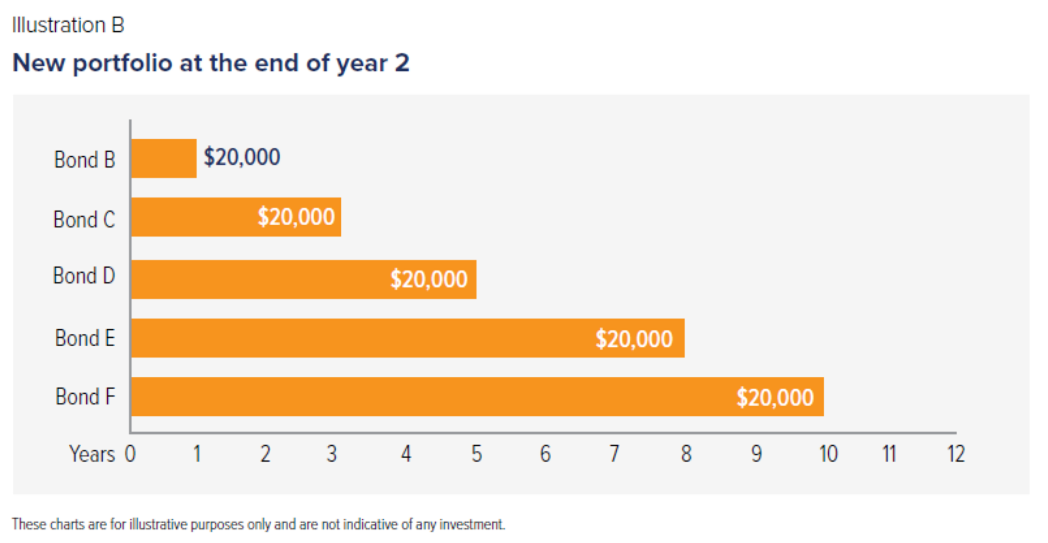 | Illustration B2 shows how the portfolio would be structured at the end of year 2. |
Bond Barbells utilize short and long maturities to balance liquidity and yield. To create a barbell, you can invest half of your assets in short-duration bonds (typically 3 years or less to maturity) and the other half in longer-term bonds (generally 10 years or more to maturity).
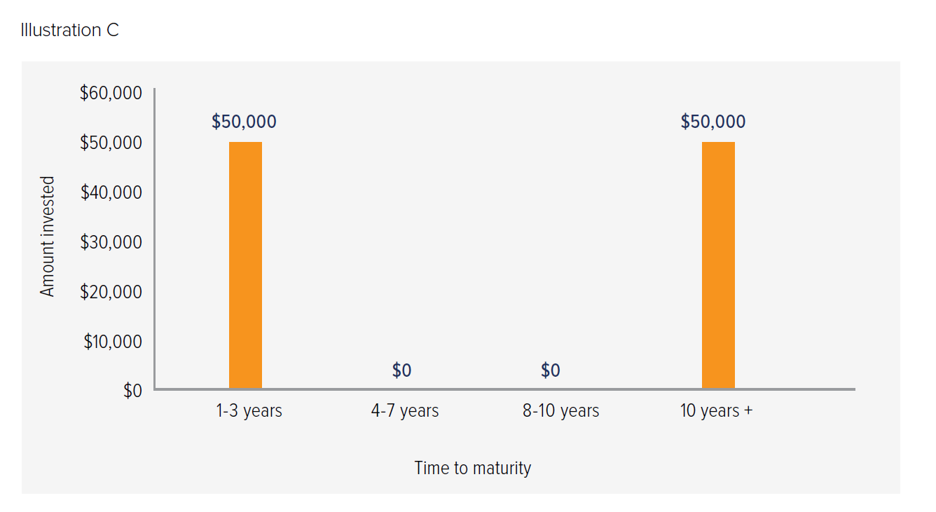 | Illustration C 2,3 shows the initial investment of $100,000 that is split into short-duration bonds with less than three years to maturity and longer-term bonds with maturities of ten years or more. |
Some investors want their bonds to pay regular income to cover recurring expenses such as college tuition payments, retirement distributions, or healthcare costs. Others simply want to know that a portion of their money will be available at a specific point in the future, whether that's next year or in three years. These two goals sound similar, but they lead to different strategies.
A ladder is built for income. By staggering bond maturities, you receive predictable coupon payments at regular intervals throughout the year. If the bonds mature at different times, you can choose to reinvest or use that principal as income. It’s like creating your own payment schedule, customized to your life.
A barbell is built for liquidity. Its short-term bonds - typically maturing within one to three years - providing predictable windows to access your money and decide what to do next. If the priority is having cash available at specific future dates rather than a steady stream of income, the barbell’s structure provides that flexibility.
Rising rates hurt existing bond prices; falling rates make reinvestment less attractive. How you weigh those two risks shapes which structure fits.
Ladders provide steady, gradual exposure to rate changes. As each rung matures, proceeds are reinvested at current rates. The result is smoothing the impact of volatility over time.
A barbell strategy3 can perform reasonably well in multiple interest rate environments: If interest rates rise, maturing short-term bonds can be reinvested at higher yields. If interest rates fall, the long-term bonds generally increase in value. The barbell structure is designed to provide exposure to both rising and falling rate scenarios, though outcomes depend on market conditions and issuer creditworthiness.
Longer-duration bonds may often offer higher yields, but the tradeoff is that they come with more price sensitivity to interest rate moves.
Ladders deliver a blended yield across all maturities providing steady, diversified income without concentrating too much in long-duration risk. They may incorporate Treasuries, Agencies and Corporate Bonds – often with higher credit ratings and lower volatility. The tradeoff is lower yield.
Ladders deliver a blended yield across all maturities providing steady, diversified income without concentrating too much in long-duration risk. They may incorporate Treasuries, Agencies and Corporate Bonds – often with higher credit ratings and lower volatility. The tradeoff is lower yield.
Every maturing bond is an opportunity to reassess the issuers in the portfolio. The more rungs that mature, the more often you get that chance.
Ladders have bonds maturing at multiple evenly spaced points, which provides regular opportunities to evaluate credit quality and rotate out of issuers whose outlook has changed.
The short-end maturities of a barbell give frequent opportunities to reassess. The locked-in long-term holdings are committed for years, resulting in less frequent opportunities.
Every maturing bond is an opportunity to reassess the issuers in the portfolio. The more rungs that mature, the more often you get that chance.
Are funding specific recurring expenses
Prefer a lower-maintenance approach
Value smoothed exposure to rate volatility
Prioritize capital preservation over yield
Are comfortable managing two distinct maturity buckets
Believe rates will rise (or want both-way coverage)
Can tolerate more price variability on the long-end
Are optimizing for total return alongside income
Both approaches are subject to the credit risk of individual issuers - if an issuer defaults, scheduled interest and principal payments could be at risk. Both carry interest rate risk for any bonds sold before maturity. And neither strategy guarantees a profit or protects against a loss in a challenging credit environment. The discipline of holding bonds to maturity is precisely what makes both strategies valuable. When you're not trying to trade around price fluctuations, interest rate risk is diminished, and the predictability of coupon payments and principal return becomes a useful investment tool. So what’s your priority? Predictable income? Flexibility and yield? Or maybe a combination of both. Speak with a financial advisor to determine how either strategy fits within your broader portfolio, tax situation, and time horizon.


SOURCES
1 Any return of principal at maturity and predictability of income payments, as outlined in the offering documents, are subject to the credit risk of the bond issuer. If an issuer defaults, some or all scheduled interest and principal payments could be at risk. Some bonds may also be subject to call risk, meaning an issuer may redeem a bond before its stated maturity date.
2 These charts are for illustrative purposes only and are not indicative of any investment. If held to maturity, bonds provide a predictable rate of return and a fixed par value, subject to the credit risk of the issuer. Bonds carry the risk of default, meaning the issuer at any time may be unable or unwilling to make scheduled interest and/or principal payments.
3 Yield Curve Risk: The effectiveness of a bond barbell strategy depends, in part, on the shape of the yield curve. During periods of a flat or inverted yield curve, the strategy may not achieve its intended objectives because longer-term securities may offer yields similar to or lower than shorter-term securities. In such market environments, investors may incur additional duration and price volatility risk without a corresponding increase in income. There can be no assurance that a bond barbell strategy will outperform other fixed-income investment approaches or achieve its investment objectives
Diversification of bond issuers and maturities does not guarantee a profit or protect against a loss. Investing in individual bonds carries additional risks that include, but are not limited to, interest rate risk, liquidity risk, reinvestment risk, and call risk. The longer the duration of a bond, the more sensitive its price is to changes in interest rates. Interest rate risk is not a concern if bonds are held to maturity. Different environments, economic periods, and market conditions will produce different results. Please refer to the information detailed in the relevant prospectus/offering documentation for a complete discussion of the terms and conditions of an offering.
DISCLAIMER
InspereX LLC and its affiliates explicitly disclaim any responsibility for product suitability or suitability determinations related to individual investors. This information should not be regarded by recipients as a substitute for the exercise of their own independent judgment, and the information provided herein is not an offer, solicitation or a recommendation to buy, sell, or hold any security or investment strategy. There can be no assurance that the investments shown herein were or will be profitable, and this material does not take into account any investor’s particular investment objectives, financial situation, particular needs, strategies, tax status, or time horizon.
The investment products discussed herein are considered complex investment products. Such products contain unique features, risks, terms, conditions, fees, charges, and expenses specific to each product. The overall performance of the product is dependent on the performance of an underlying or linked derivative financial instrument, formula, or strategy. Return of principal is not guaranteed and is subject to the credit risk of the issuer. Investments in complex products are subject to the risks of the underlying reference asset classes to which the product may be linked, which include, but are not limited to, market risk, liquidity risk, call risk, income risk, reinvestment risk, as well as other risks associated with foreign, developing, or emerging markets, such as currency, political, and economic risks. Depending upon the particular complex product, participation in any underlying asset (“underlier”) is subject to certain caps and restrictions. Any investment product with leverage associated may work for or against the investor. Market-Linked Products are subject to the credit risk of the issuer. Investors who sell complex products or Market-Linked Products prior to maturity are subject to the risk of loss of principal, as there may not be an active secondary market. You should not purchase a complex investment product until you have read the specific offering documentation and understand the specific investment terms, features, risks, fees, charges, and expenses of such investment.
The information contained herein does not constitute an offer to sell or a solicitation of an offer to buy securities. Investment products described herein may not be offered for sale in any state or jurisdiction in which such as offer, solicitation, or sale would be unlawful or prohibited by the specific offering documentation.
For all Market-Linked Products, excluding Market-Linked CDs, the following applies: Not FDIC insured // Not bank guaranteed // May lose value // Not a bank deposit // Not insured by any government agency
©2026 InspereX. All rights reserved. Securities offered through InspereX LLC, Member FINRA/SIPC. InspereX and insperex.com are trademarks of Incapital Holdings LLC.