
Loading component...

June 9, 2026
Today’s market environment — characterized by persistent volatility, shifting interest rate expectations, and ongoing macroeconomic uncertainty — has intensified pressure on advisors to construct portfolios that can both manage the turbulence while also taking advantage of products that may offer some reliable income investing outcomes. Clients are increasingly focused on stability, and advisors have a unique opportunity to demonstrate value through solutions designed for long‑term resilience rather than short‑term predictions or market timing.
One of the most notable shifts in this environment is the growing use of income-generating structured products. By combining market exposure, risk‑management features, and tailored characteristics, income-oriented structured products offer advisors a flexible way to help clients stay invested during uncertainty.
Structured products—also called market‑linked products—are investment solutions whose returns are tied to the performance of one or more underlying assets, such as indices, equities, sectors, or ETFs. They can offer full principal protection at maturity through Market‑Linked CDs (which are FDIC-insured up to applicable limits) or Principal Protected Notes (subject to the credit risk of the issuer), as well as partial or defined downside protection through Market‑Linked Notes1.
Income‑oriented structured products, in particular, generate cash flow through coupon payments – either fixed or contingent. Fixed coupons provide steady predictable income regardless of the performance of the underlying asset. However, it is important to note that the final return of principal is linked to the performance of the underlying asset.
Contingent coupons offer higher yield potential paid only when the underlying asset stays above a predetermined barrier at scheduled observation dates. For example, a note with a coupon barrier of 80% pays if the performance of the underlier does not fall below 20% of the initial level on the predetermined observation dates.
If the underlying asset stays above the barrier, you receive your full principal back, along with potential coupons. If the asset falls below the barrier, your principal may be at risk, depending on the product and as outlined in the offering documents.
Periods of market stress often result in investors looking to move to cash or delay reinvestment — decisions that can significantly undermine long‑term portfolio performance. Advisors play a central role in helping clients avoid emotional investing and remain aligned with long‑term financial goals.
As the chart below illustrates, staying invested versus trying to time the market, may be one of the most reliable ways to capture market recoveries and compound growth over time. Structured products help support this disciplined approach by providing defined terms, consistent income opportunities, and varying levels of downside protection. These features give clients greater clarity and confidence during volatility.
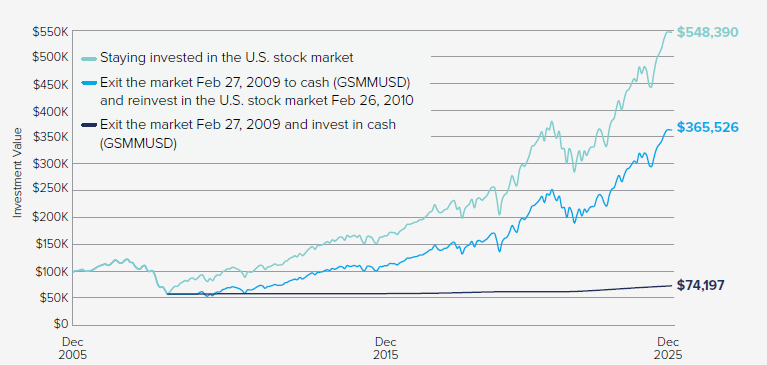
| Source: Bloomberg. Data represents the last trading day for the period December 2005 to December 2025. This chart is for illustrative purposes only and assumes a $100,000 investment December 30, 2005. The market is represented by the S&P 500®, which is an unmanaged group of securities and considered to be representative of the U.S. stock market in general. Cash is represented by the month over month percentage change using the end of month closing price of the Goldman Sachs Overnight Money Market Index (GSMMUSD). Past performance is no guarantee of future results. An investment cannot be made directly in an index. The data assumes no dividends are received and does not account for taxes or transaction costs of an initial investment of $100,000. |
Advisors are shifting toward highly customized investment solutions. Structured products align well with this trend because they can be tailored to meet specific income, risk management, and market exposure goals.
According to the InspereX 2026 Spring Advisor Pulse Survey2 of 783 financial advisors, 55% plan to increase their use of structured products in 2026, more than any other income‑oriented investment category. An additional 31% expect to use more Market‑Linked CDs, reflecting growing demand for defined‑outcome income solutions.
As correlations rise across traditional asset classes and portfolio concentrations increase, advisors are looking for diversified income streams and structured products are increasingly filling that gap. Income‑oriented structured products can enhance resilience by providing:
Income sources that behave differently from traditional fixed income
Risk‑managed equity exposure with protective features
Tools to help manage concentrated stock positions
A core advantage of coupon‑paying structured notes — especially those with defined levels of protection at maturity — is their ability to offer the enhanced yield potential relative to traditional fixed income. This incremental income is possible because investors accept a degree of market risk within a clearly defined framework.
Enhanced Income Potential - Issuers can offer higher coupons in exchange for exposure to the potential for missed coupon payments if the performance of the underlying asset drops below the predetermined threshold level – or coupon barrier - at predetermined dates. The coupon barrier guards against loss of principal based on possible decline of underlier from the initial level (100%) through to the specified protection level.
Defined Protection - Market‑Linked CDs (which are FDIC insured up to applicable limits) and Principal Protected Notes return full principal at maturity (subject to issuer credit risk for notes), regardless of underlying performance. Market‑Linked Notes typically provide a defined level of downside protection at maturity1.
Maturities, coupon barriers, and call features are clearly defined, allowing advisors to model outcomes across multiple scenarios. Many income‑oriented notes also include autocall features, which may return principal early along with a final coupon payment if conditions are met. Like callable bonds, Autocallable Notes have the potential to be called prior to maturity if the value of the underlier is at or above a predetermined call level as set out in the offering documents. If called, investors will receive full principal back in addition to a call premium1.
As advisors guide clients through uncertain markets, income‑generating structured products have emerged as powerful tools for strengthening portfolio resilience. Their ability to deliver customizable income, risk-managed market exposure, and diversified return streams aligns well with what today’s investors need most – stability, clarity, and confidence.
Integrating structured products into a broader asset‑allocation framework helps clients remain invested, stay confident through market volatility, and continue pursuing long‑term financial goals. To learn how structured products can fit into your clients’ portfolios, explore InspereX’s structured product solutions or connect with an InspereX specialist.


FOOTNOTES
1 Any return of principal, as well as interest and gains generated, are subject to the credit risk of the issuer and terms of the offering documents, which could include participation rates, interim caps, and various risks. Dividends paid on the underlying asset are not passed through to the Market-Linked Product. There is no guarantee that a Market-Linked Product will generate a positive return. Any applicable downside protection will be realized only at maturity, which may range up to 10 years. For certain Market-Linked Notes, return at maturity could be less than the original amount invested. Regarding Market-Linked CDs, the Federal Deposit Insurance Corporation (FDIC) insures principal amounts up to applicable limits in the event the issuer becomes insolvent.
2 The 2026 InspereX Spring Advisor Pulse Survey was conducted from March 27 to April 7, 2026, by Red Zone Marketing on behalf of InspereX. The 783 financial advisors responding work at independent broker/dealers, RIAs, banks, regional firms and wirehouses.
DISCLAIMER
InspereX LLC and its affiliates explicitly disclaim any responsibility for product suitability or suitability determinations related to individual investors. This information should not be regarded by recipients as a substitute for the exercise of their own independent judgment, and the information provided herein is not an offer, solicitation or a recommendation to buy, sell, or hold any security or investment strategy. There can be no assurance that the investments shown herein were or will be profitable, and this material does not take into account any investor’s particular investment objectives, financial situation, particular needs, strategies, tax status, or time horizon.
The investment products discussed herein are considered complex investment products. Such products contain unique features, risks, terms, conditions, fees, charges, and expenses specific to each product. The overall performance of the product is dependent on the performance of an underlying or linked derivative financial instrument, formula, or strategy. Return of principal is not guaranteed and is subject to the credit risk of the issuer. Investments in complex products are subject to the risks of the underlying reference asset classes to which the product may be linked, which include, but are not limited to, market risk, liquidity risk, call risk, income risk, reinvestment risk, as well as other risks associated with foreign, developing, or emerging markets, such as currency, political, and economic risks. Depending upon the particular complex product, participation in any underlying asset (“underlier”) is subject to certain caps and restrictions. Any investment product with leverage associated may work for or against the investor. Market-Linked Products are subject to the credit risk of the issuer. Investors who sell complex products or Market-Linked Products prior to maturity are subject to the risk of loss of principal, as there may not be an active secondary market. You should not purchase a complex investment product until you have read the specific offering documentation and understand the specific investment terms, features, risks, fees, charges, and expenses of such investment.
The information contained herein does not constitute an offer to sell or a solicitation of an offer to buy securities. Investment products described herein may not be offered for sale in any state or jurisdiction in which such as offer, solicitation, or sale would be unlawful or prohibited by the specific offering documentation.
For all Market-Linked Products, excluding Market-Linked CDs, the following applies: Not FDIC insured // Not bank guaranteed // May lose value // Not a bank deposit // Not insured by any government agency