
Loading component...

March 24, 2026
In today’s climate of geopolitical tension, inflation concerns, and choppy markets, financial advisors are demonstrating that the strong foundations they’ve built enable clients to remain comfortably invested and focused on long‑term goals. Against this backdrop of uncertainty, advisors are increasingly relying on strategies that help clients stay disciplined — especially those centered on protection.
The InspereX Spring 2026 Advisor Pulse Survey1 highlighted a central theme shaping advisor behavior today: demand for protection and transparency is accelerating. Unpredictable markets change the tone of client conversations and raise the bar for demonstrating advisor value. As a result, risk‑managed protection strategies have shifted from “nice to have” to essential tools for keeping clients invested and grounded in long‑term planning.
Over half of surveyed advisors said they plan to implement additional protection strategies in 2026. Among the top reasons:
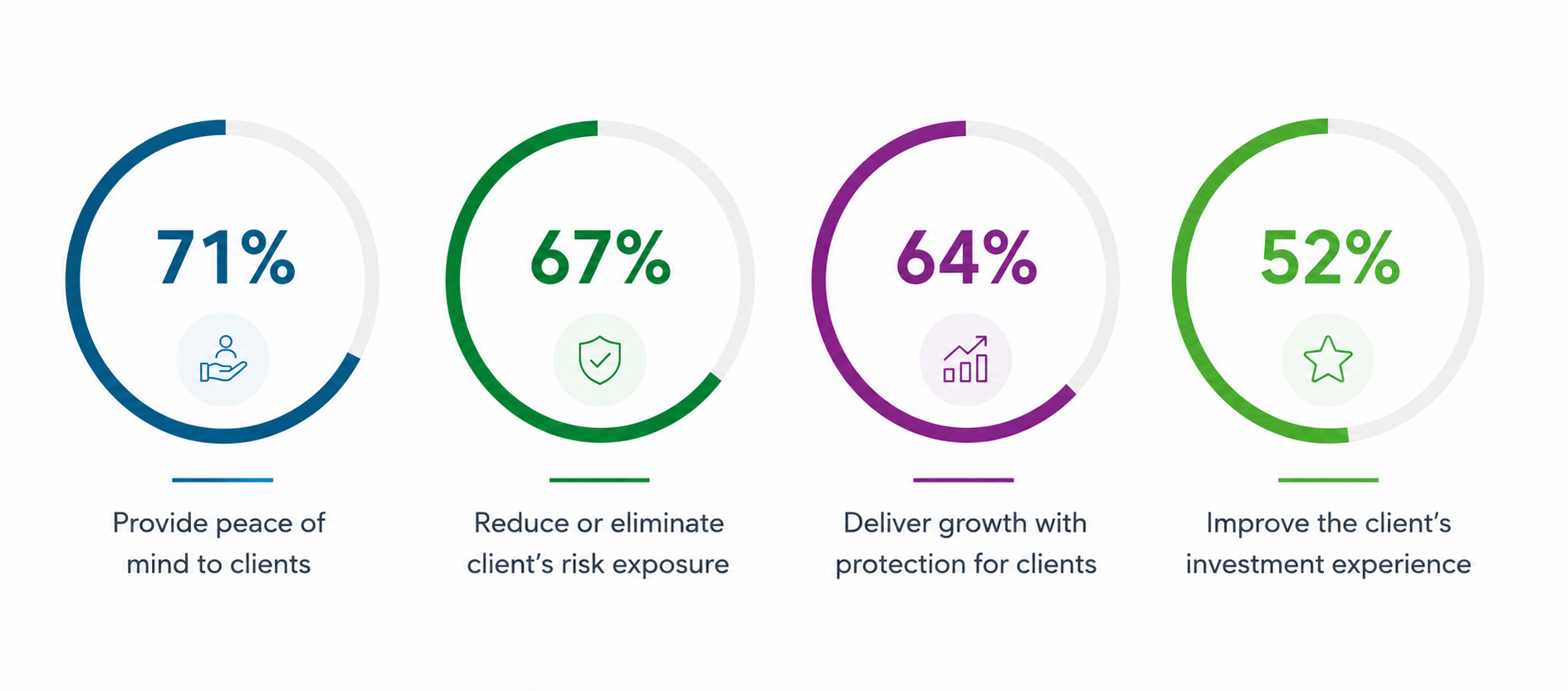
This emphasis on protection reflects a broader historical truth: long‑term market gains are neither smooth nor free of volatility. Research from MSCI examining daily U.S. equity-market drawdowns from 1946 to 2024 found that on 92% of all days, the market was below its previous peak—despite delivering an annualized return of 7.7%.2 This gap between daily experience and long-term results underscores why clients often feel uneasy even in generally strong markets.
To help bridge that emotional gap, advisors are turning to solutions designed to offer clarity, defined outcomes, and measurable downside protection. They also look for varying sources of income with downside protection. The top five assets they anticipate using in 2026 are:
Structured Products
Dividend Paying Stocks
Indexed Annuities
Market‑Linked CDs
Bond Funds/ETFs
In a competitive advisory landscape, the ability to articulate and deliver meaningful protection has become a key differentiator. Protection‑oriented solutions elevate advisor value in ways clients feel directly:
When clients know that built‑in protection cushions potential downturns, they are less likely to panic or deviate from long‑term plans.
Protection strategies allow advisors to manage client emotions in volatile markets by redirecting conversations away from the emotion and toward a structured, disciplined investment approach – reinforcing their role as an advisor versus a forecaster.
Mitigating downside risk helps clients avoid costly market timing mistakes and maintain participation in growth opportunities. The result is a more consistent and confident investment experience.
While multiple tools can support a protection‑focused approach, structured products stand out for their dual benefit: they protect clients while strengthening the advisor’s business. When surveyed, advisors reported that these tools help them:
Differentiate their practice (59%)
Strengthen client relationships (50%)
Create better client experiences (49%)
Grow their business (41%)
Increase AUM (40%)
Gain a competitive advantage (39%)
Attract more affluent clients (36%)
In other words, structured products don’t just help clients — they help advisors articulate a more compelling value proposition. Integrating them into client portfolios can:
Reinforce your identity as a sophisticated risk manager
Enable more tailored conversations around defined outcomes
Demonstrate commitment to protecting what clients have built
Support prospecting efforts by offering solutions often associated with high‑net‑worth planning
At a time when clients measure value not only by performance but also by how protected and guided, they feel these benefits matter more than ever.
Advisors are increasingly rejecting the idea that growth and protection exist at opposite ends of a spectrum. Instead, they’re embracing solutions that allow clients to pursue both simultaneously.
By leaning into a variety of protection strategies, advisors can meet these expectations while strengthening their own competitive edge. As markets continue to fluctuate, protection isn’t simply a defensive tactic — it’s a long-term strategic necessity.
By leaning into a variety of protection strategies, advisors can meet these expectations while strengthening their own competitive edge. As markets continue to fluctuate, protection isn’t simply a defensive tactic — it’s a long-term strategic necessity.


FOOTNOTES
1 2026 InspereX Spring Advisor Pulse Survey was conducted from March 27th to April 7th, 2026 by Red Zone Marketing on behalf of InspereX. The 783 financial advisors responding work at independent broker/dealers, RIAs, banks, regional firms and wirehouses.
2 Source: Fama-French Data Library, MSCI – https://www.msci.com/research-and-insights/blog-post/a-historical-look-at-market-downturns-to-inform-scenario-analysis
DISCLAIMER
InspereX LLC and its affiliates explicitly disclaim any responsibility for product suitability or suitability determinations related to individual investors. This information should not be regarded by recipients as a substitute for the exercise of their own independent judgment, and the information provided herein is not an offer, solicitation or a recommendation to buy, sell, or hold any security or investment strategy. There can be no assurance that the investments shown herein were or will be profitable, and this material does not take into account any investor’s particular investment objectives, financial situation, particular needs, strategies, tax status, or time horizon.
The investment products discussed herein are considered complex investment products. Such products contain unique features, risks, terms, conditions, fees, charges, and expenses specific to each product. The overall performance of the product is dependent on the performance of an underlying or linked derivative financial instrument, formula, or strategy. Return of principal is not guaranteed and is subject to the credit risk of the issuer. Investments in complex products are subject to the risks of the underlying reference asset classes to which the product may be linked, which include, but are not limited to, market risk, liquidity risk, call risk, income risk, reinvestment risk, as well as other risks associated with foreign, developing, or emerging markets, such as currency, political, and economic risks. Depending upon the particular complex product, participation in any underlying asset (“underlier”) is subject to certain caps and restrictions. Any investment product with leverage associated may work for or against the investor. Market-Linked Products are subject to the credit risk of the issuer. Investors who sell complex products or Market-Linked Products prior to maturity are subject to the risk of loss of principal, as there may not be an active secondary market. You should not purchase a complex investment product until you have read the specific offering documentation and understand the specific investment terms, features, risks, fees, charges, and expenses of such investment.
The information contained herein does not constitute an offer to sell or a solicitation of an offer to buy securities. Investment products described herein may not be offered for sale in any state or jurisdiction in which such as offer, solicitation, or sale would be unlawful or prohibited by the specific offering documentation.
For all Market-Linked Products, excluding Market-Linked CDs, the following applies: Not FDIC insured // Not bank guaranteed // May lose value // Not a bank deposit // Not insured by any government agency